vv x
An egg wash affects how a baked product looks when it leaves the oven. On an industrial line, it also needs to spread evenly, work with the applicator and deliver a repeatable finish across every batch.
Whole egg, egg yolk and egg white can all be used as a bakery coating, but they serve different visual and functional goals. The right choice depends on the product, the desired color and shine, whether toppings must adhere, and how the wash is applied.
This guide gives bakery teams a way to shortlist an egg format and test it under production conditions.
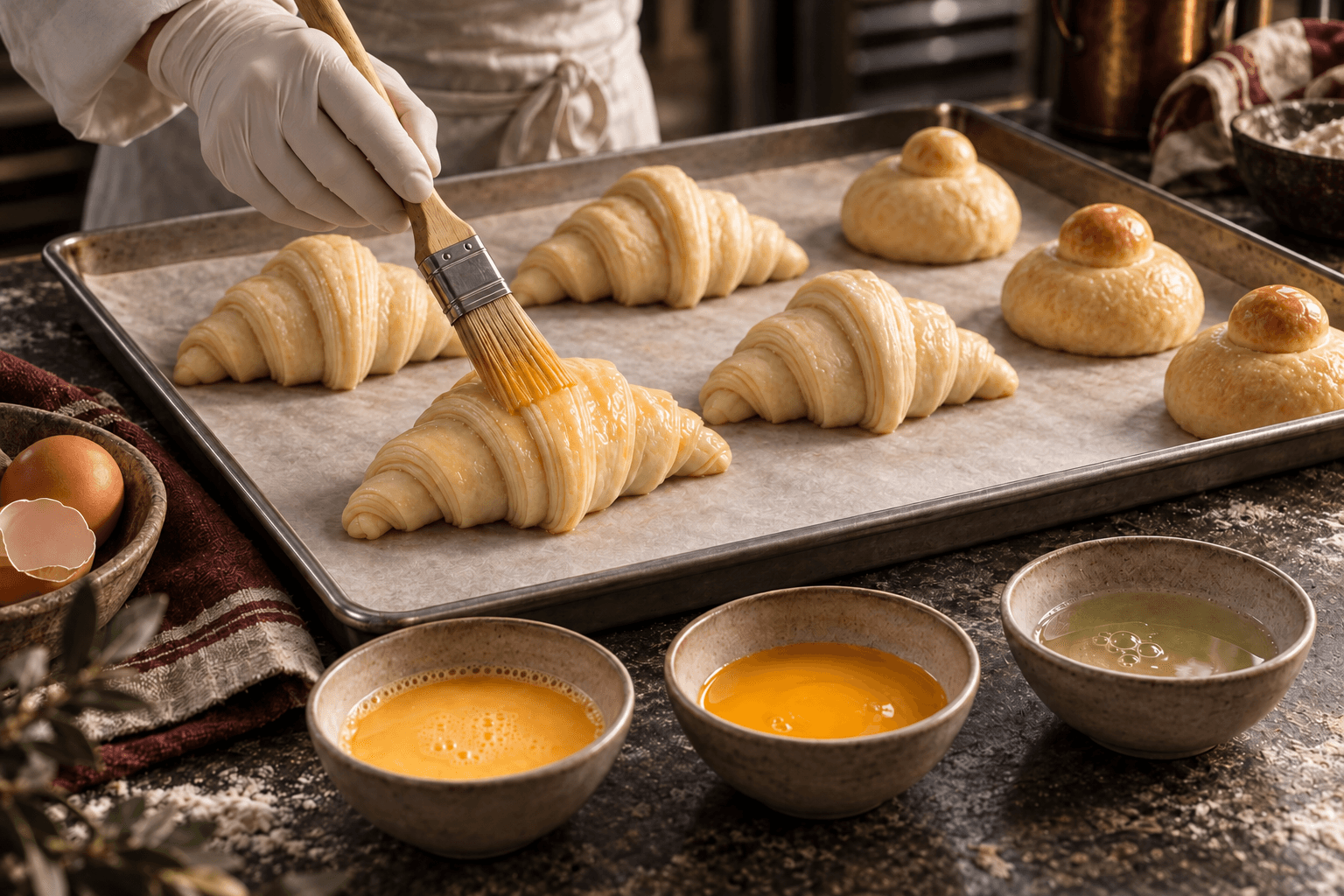
Quick Answer: Which Egg Wash Should You Test First?
Your main goal | Starting option | What to check in a trial |
|---|---|---|
A balanced golden finish with moderate shine | Whole egg liquid | Color and coverage across the full product surface |
Deeper golden color and stronger gloss | Egg yolk liquid | Whether the coating is too thick or browns too strongly |
A lighter finish or adhesion for seeds and other toppings | Egg white liquid | Topping retention, surface feel and final color |
These are starting points, not fixed recipes. The American Egg Board identifies different coating, color and shine properties for egg white, whole egg and yolk. The baked result also depends on the dough, oven and application method. See its egg-product guide.
Begin with the Finished Product
Before comparing ingredients, write down what a successful finish looks like.
A croissant may need an even golden surface that shows the shape of its layers. A soft roll may need restrained color and shine. A seeded bun needs the topping to stay attached through baking, packing and handling. A hand pie may need its edges sealed as well as a finished surface.
For each product, define:
The target color and shine, ideally with an approved photograph or physical sample.
Where the wash should be applied and where it should be avoided.
Whether seeds, grains or other toppings must adhere.
The acceptable variation between the top, sides and edges.
The appearance after cooling and packing, not only at oven exit.
This gives production and purchasing teams a shared standard. “More golden” is difficult to measure consistently; a defined reference product is easier to approve.
How Whole Egg, Yolk and White Differ
Whole egg liquid is a useful first trial when the bakery wants color, shine and topping adhesion in one coating. It provides a balanced starting point for products such as rolls, buns and pastries.
Egg yolk liquid is worth testing when a deeper yellow-gold appearance and stronger gloss are the priorities. Its thickness may need adjustment for the selected applicator. Compare the finish after the complete baking cycle: an attractive result at one oven setting may become too dark under another.
Egg white liquid is useful to assess when adhesion matters more than a rich golden color. Egg proteins can help seeds or nuts attach to the surface during baking. It can also be a starting point for products where a lighter finish is preferred.
The American Egg Board describes both the finishing role of egg products and their use in holding toppings on baked goods. Treat those functional differences as a guide for trials, then approve performance on your own recipe and line. Coatings and finishes · Adhesion
The Application Method Changes the Result
The same egg liquid can behave differently when brushed, sprayed or applied by another coating system. An ingredient that looks right in a small hand-finished trial still needs to pass through the bakery’s production equipment.
Brush application
Brushing lets an operator work around folds, seams and delicate shapes. It is useful during development or for products requiring selective coverage.
For a fair trial, apply a consistent amount to each sample. Record whether the brush pulls the surface, leaves visible strokes or collects liquid at the edges.
Spray application
Spraying may suit higher-throughput lines, but the wash must work with the equipment. Check coverage, overspray, buildup around nozzles and any change in application during a production run.
Avoid choosing a dilution by appearance alone. Adding liquid can change flow and coverage as well as the final color and gloss. Establish an approved mixture and record how it is prepared.
Other coating systems
For a disc, roller or other automated applicator, ask the equipment supplier which product properties matter to that system. Then test the shortlisted egg liquid at the intended line speed and settings.
Whatever the method, record egg wash used per acceptable finished unit. That figure helps compare both appearance and operating cost.
Run a Controlled Comparison
A useful trial changes one variable at a time. Start with the same dough batch, product size, proofing conditions, oven program and application method. Compare whole egg, yolk and white against the bakery’s current finish or approved target.
For each sample, record:
Coverage: Is the surface even, including curves and edges?
Color: Does it match the target after baking and cooling?
Shine: Does the finish still look right at packing time?
Topping retention: For seeded products, what remains attached after normal handling?
Line performance: Does the wash apply consistently throughout the run?
Use per unit: How much liquid is consumed for an acceptable result?
Photograph samples under the same lighting. Include a close view and a full-tray view: one piece can look convincing while a tray reveals uneven application.
If the first result is unsuitable, adjust one factor—such as the egg format, approved mixture or application setting—and repeat. This makes it easier to identify what improved the finish.
Compare Cost by Acceptable Finished Product
The lowest price per kilogram may not produce the lowest cost per sellable bun or pastry.
Calculate the cost using egg wash consumption and finished-product yield:
Egg wash cost per acceptable unit = total egg wash cost used in the trial ÷ number of acceptable finished units
Then consider the operating costs that differ between options, such as preparation time, coating waste, equipment cleaning and rejected products. Use the same cost boundary for every option.
A darker coating is only useful if it meets the product brief. Applying more wash than necessary may increase cost without improving the result.
What to Ask an Egg Liquid Supplier
Once the bakery has shortlisted a format, request the specification for the exact product being sampled. Confirm its ingredients, packaging, storage and handling instructions, shelf life, lot identification and supply terms.
For an international project, also discuss the destination market and whether the proposed product, manufacturing site and shipping route meet the buyer’s requirements. Chilled, frozen and powdered formats create different planning needs.
Jinyi Food lists pasteurized whole egg liquid and pasteurized egg yolk liquid among its products, as well as other liquid egg formats. Product availability and suitability for a particular coating process should be confirmed against the current specification and a production trial.
When requesting a sample, send the supplier:
The bakery product and target appearance.
Photos of the current and desired finish.
Whether toppings must adhere.
The applicator type and approximate production conditions.
Required egg format, packaging and estimated volume.
Destination country and delivery requirements.
This information helps the supplier recommend a practical starting sample and makes the trial more relevant.
Frequently Asked Questions
Which egg wash gives baked goods a darker golden color?
Egg yolk is a starting point for a deeper golden finish. Test it on the actual product, because dough composition, application amount and baking conditions affect the final color.
Is whole egg liquid suitable for an industrial egg wash?
It can be a starting option where a bakery wants both color and shine. Confirm that the specific liquid product works with your applicator and achieves an even finish at production speed.
Should a bakery use egg white to hold seeds on buns?
Egg white is worth including in an adhesion trial. Test topping retention after baking, cooling and routine handling, alongside the appearance of the finished bun.
Can the same egg wash be used for every bakery product?
A shared wash may simplify operations, but products with different surfaces, toppings and appearance targets may need different application settings or formulations. Approve it against each product specification.
Start with a Sample Trial
For an egg wash project, the most useful first step is a comparison on your own baked product. Share your finish target, applicator and production requirements with Jinyi Food to discuss a suitable egg ingredient sample and the product documentation needed for evaluation.
