Articles
By Jinyi Food Technical Solutions Team
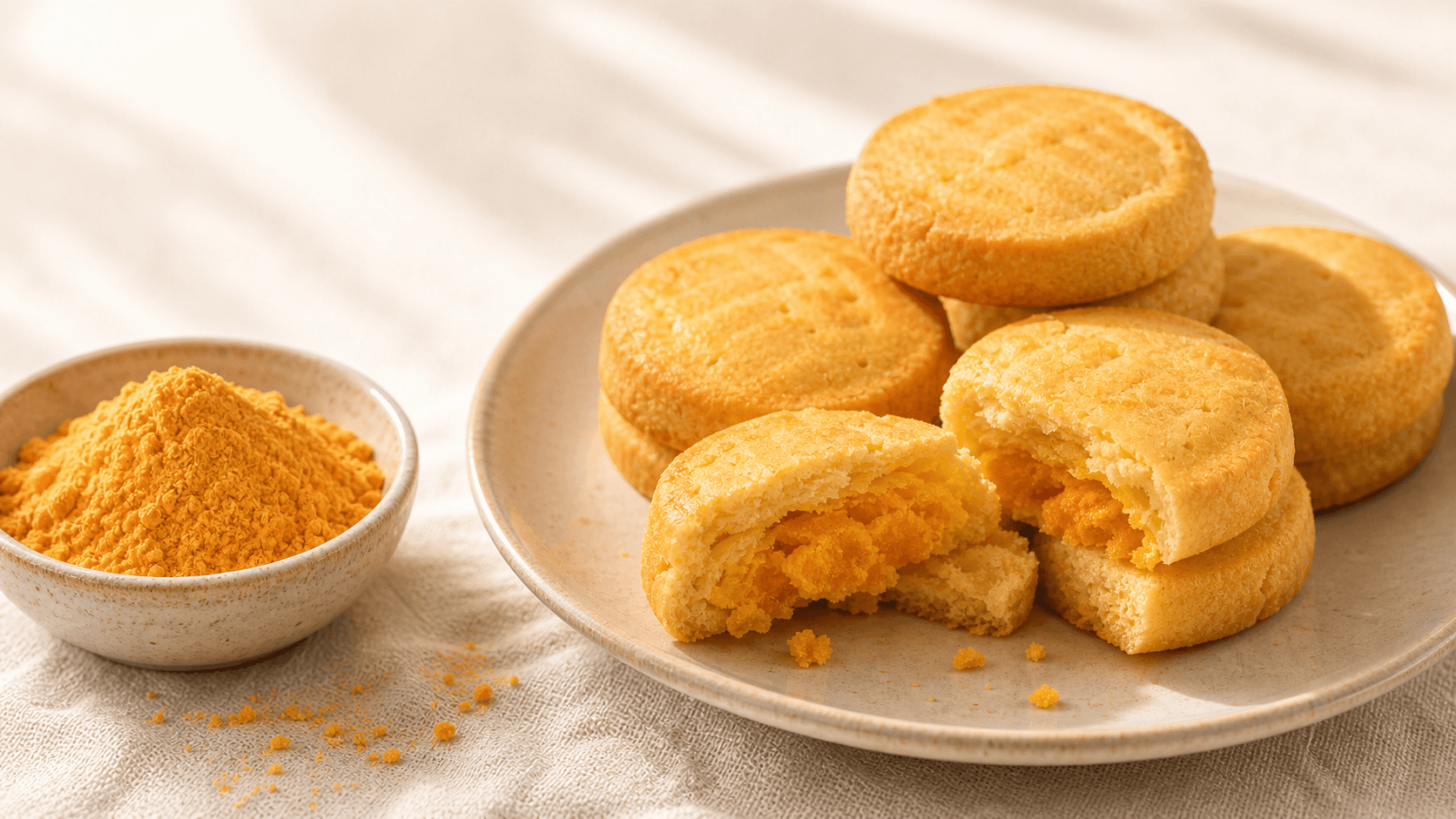
Salted egg yolk powder is a shelf-stable ingredient used to add rich yolk aroma, savory umami character and golden color to snacks, baked goods, seasonings, sauces and prepared foods.
For food manufacturers, its main advantage is control. A dry, measurable ingredient is easier to dose and standardize across production batches than fresh or frozen salted yolks. It can be incorporated into a seasoning blend, bakery filling, dough, sauce system or foodservice finishing mix.
Jinyi Food’s salted egg yolk powder is made from chicken egg yolks rather than duck egg yolks. Under Jinyi Food’s production model, chicken egg yolks offer practical advantages in raw-material cost, supply availability and food-safety management. The integrated chicken egg supply chain also supports more consistent hygiene control, processing records and product traceability.
Key Takeaways
Salted egg yolk powder works in both sweet and savory food applications.
High-potential categories include coated snacks, bakery fillings, fried-food seasonings, instant noodles, sauces and ready meals.
Current food trends favor Asian-inspired flavors, umami depth, category crossovers and modern interpretations of traditional foods.
Chicken-based salted egg yolk powder can provide a milder flavor, cost advantages and more standardized raw-material control.
Buyers should evaluate flavor, salt level, particle size, oxidation stability, microbiology, allergen documentation and application performance.
Salted egg yolk powder and heat-stable egg yolk powder are not automatically interchangeable.

Why Salted Egg Yolk Flavor Fits Current Food Trends
Global flavor innovation is moving beyond broad descriptions such as “Asian flavor.” Product developers are increasingly looking for ingredients with a recognizable origin, a clear sensory identity and the flexibility to work in familiar food formats.
The USDA Foreign Agricultural Service’s report on food and beverage trends for 2026 highlights complex flavors, regional specialties, umami depth and contrasting textures. It also describes an “affordable premium” shift in which consumers look for distinctive experiences in accessible formats such as convenience foods and single-portion treats.
ADM’s 2026 Flavor and Color Trends identifies global taste expansion, cuisine mash-ups, category crossovers and “newstalgia”—familiar flavors reinterpreted in modern applications.
McCormick Flavor Solutions similarly points to Asian flavors, umami, complex spice blends and Asian bakery-café culture as sources of product-development inspiration.
Salted egg yolk fits this intersection. It has a traditional Asian culinary identity, but it can also be applied to globally familiar products. A consumer does not need to understand the traditional curing process to appreciate the combination of rich umami seasoning and a crunchy potato chip, or a golden salted-yolk filling inside a flaky croissant.
What Is Salted Egg Yolk Powder?
Salted egg yolk powder is made by processing cured egg yolks into a dry, free-flowing ingredient. It is used primarily for flavor, aroma and color, although its fat and protein content can also influence mouthfeel and product structure.
In commercial production, the powder offers several practical benefits:
Measurable addition to standardized recipes
Easy incorporation into dry seasoning blends
More consistent flavor and color between batches
Ambient storage when supported by the supplier’s specification
Less preparation than cooking and processing whole salted yolks
Easier storage, handling and transportation
Compatibility with both sweet and savory applications
Powder is not always the correct format. Whole or frozen salted yolks may still be preferred when visible yolk pieces or a coarse, traditional texture are central to the product.
The correct ingredient format should be selected according to the sensory target, manufacturing process and final product positioning.
Why Jinyi Food Uses Chicken Egg Yolks
Traditional salted yolk products are often associated with duck eggs. Jinyi Food takes a different approach: its salted egg yolk powder is made from chicken egg yolks.
For Jinyi Food’s manufacturing and supply-chain model, chicken egg yolks provide four important B2B advantages.
1. More Cost-Efficient Raw Material
Chicken eggs generally fit more efficiently into Jinyi Food’s existing industrial egg supply and processing system. This can provide a more competitive ingredient cost than relying on a separate duck egg supply chain.
For snack, bakery and ready-meal manufacturers, the cost advantage becomes especially relevant when the ingredient is used across large production volumes.
The final cost-in-use should still be evaluated according to dosage, flavor intensity, product yield and processing performance—not only the price per kilogram.
2. More Stable Raw-Material Supply
Jinyi Food operates an integrated chicken egg supply chain covering farming, egg collection and egg processing.
Using chicken egg yolks allows the salted egg yolk powder to connect directly with this established raw-material system. This supports more consistent supply planning and reduces dependence on a smaller or less standardized external raw-material category.
Stable raw-material availability is important for manufacturers launching permanent product lines rather than short-term seasonal products.
3. Stronger Hygiene and Food-Safety Management
The food-safety advantage comes from the controlled production system rather than from simply declaring one egg species “safe” and another “unsafe.”
Because Jinyi Food’s chicken egg raw materials are managed within an integrated production and processing system, the company can apply more standardized controls to egg collection, handling, processing, hygiene management, batch records and traceability.
This gives B2B buyers a clearer path for reviewing:
Raw-material origin
Processing records
Microbiological specifications
Allergen documentation
Batch traceability
Certificate of Analysis
Storage and handling conditions
Properly processed duck egg products can also be safe. The practical advantage of Jinyi Food’s chicken-based product is that it is connected to the company’s established chicken egg supply and quality-management system.
4. Milder and More Adaptable Flavor
Chicken-based salted egg yolk powder can provide a milder yolk profile than strongly flavored traditional duck yolk ingredients.
This makes it easier to adapt the flavor for international consumers and for products in which salted yolk is intended to complement—not overpower—other ingredients.
Possible pairings include:
Chili and curry leaf
Nori and sesame
Garlic and scallion
Cheese
Seafood seasoning
Sweet custard
Butter and cream
Black pepper
Manufacturers should conduct side-by-side sensory trials because the final result also depends on curing method, salt level, processing conditions and the complete formulation.
Seven Scalable Salted Egg Yolk Powder Applications
1. Potato Chips with Salted Egg Yolk and Chili
Potato chips are a practical entry point because their neutral starch base carries savory and fat-soluble flavors well.
Salted egg yolk powder can provide a creamy, umami foundation, while chili, curry leaf, black pepper or a tangy component adds contrast.
Possible product directions include:
Salted egg yolk and chili crisp
Salted egg yolk and black pepper
Salted egg yolk with curry leaf
Salted egg yolk and seaweed
Salted egg yolk and cheese
The main technical question is not only flavor intensity. The seasoning must adhere evenly without creating excessive dust, oily patches or color variation.
Particle-size compatibility between the yolk powder, salt, sugar, spices and carrier system should be tested on the actual production line.
Research published in The Journal of Applied Science found that particle size affected how well spicy salted egg yolk seasoning adhered to fried potato chips. The specific result belongs to that study’s formulation, but the practical lesson is broader: coating performance should be validated rather than assumed.
2. Rice Crackers and Extruded Snacks
Rice crackers and extruded corn snacks allow brands to combine a familiar crunchy format with a more distinctive Asian-inspired flavor.
Salted egg yolk powder can be paired with:
Nori
Sesame
Roasted garlic
Scallion
Chili
Curry
Seafood flavors
The snack base affects seasoning performance. A porous extruded snack may retain powder differently from a smooth rice cracker.
Manufacturers should compare tumbling, oil-assisted coating and slurry application methods, then measure seasoning pickup, loose powder and flavor uniformity.
This category is especially suitable for distributors and private-label teams that want a differentiated SKU without developing an entirely new snack platform.
3. Popcorn and Coated Nuts
Popcorn and nuts can position salted egg yolk as a premium but accessible flavor.
Potential channels include:
Cinemas
Convenience stores
Travel retail
Warehouse clubs
Foodservice snack programs
Private-label retail
Because popcorn and nuts already contain oil, formulation teams should monitor overall richness and oxidation stability.
The goal is a rounded yolk flavor rather than a heavy or stale finish. Barrier packaging, oxygen control and shelf-life testing should therefore be included in product development.
For coated nuts, the seasoning system must also have enough adhesion to survive packing and transportation.
4. Lava Croissants, Buns, Cookies and Bakery Fillings
Salted egg yolk has a natural role in Asian bakery, but the opportunity extends beyond traditional mooncakes.
It can be used to create sweet-savory contrast in:
Lava croissants
Filled buns
Sandwich cookies
Custard fillings
Laminated pastries
Cakes
Bakery premixes
Three application routes are possible:
Incorporation into dough or batter
Addition to a fat-based or custard-style filling
Surface dusting after baking
Each route creates a different sensory result.
A filling can deliver a concentrated center, while dough incorporation produces a more even but milder flavor. Surface application creates an immediate aroma but may be more sensitive to powder loss and moisture pickup.
Jinyi Food’s current salted egg yolk powder specification lists 3%–8% as a reference range for bakery dough.
This should be treated as a development starting point, not a universal formula. Sugar, fat, water activity, baking temperature and competing flavors will affect the final dosage.
5. Fried Chicken, Fries and Foodservice Seasonings
Salted egg yolk seasoning can help restaurant chains and central kitchens add a recognizable flavor without preparing a fresh yolk sauce at every location.
Potential foodservice applications include:
Fried chicken finishing powder
French fry seasoning
Potato wedges
Onion rings
Fried seafood
Rice bowls
Noodle dishes
Limited-time menu products
For foodservice use, the blend must be easy to dose and tolerant of operator variation.
A finishing seasoning should be evaluated for clumping, flowability and adhesion under actual service conditions. Pack size should also match expected daily usage so that opened products are not repeatedly exposed to moisture and kitchen humidity.
6. Instant Noodles and Dry Seasoning Sachets
Instant noodle manufacturers can use salted egg yolk powder in a dry sachet, combined seasoning system or separate finishing packet.
It can also support:
Dry soup mixes
Cup rice
Convenience meal kits
Dry-tossed noodles
Snack noodles
Instant pasta
Product developers should first decide whether the target is a creamy soup, dry-tossed noodle or lighter savory accent.
The ingredient will perform differently in water, oil and starch systems. Solubility, dispersion, surface oil and flavor release should therefore be evaluated in the complete product—not only in the dry seasoning blend.
Because the seasoning contains egg, allergen communication must be clear, especially in categories where consumers may not expect an egg-derived ingredient.
7. Sauces, Frozen Meals and Ready-to-Heat Products
Salted egg yolk powder can be used in sauces for pasta, seafood, chicken, vegetables, fried rice and other ready meals.
It can also support frozen entrées where manufacturers require standardized flavor across high-volume production batches.
This application requires careful ingredient selection.
A powder selected mainly for snack flavor may not provide the emulsification or heat stability needed in a pasteurized sauce. If the process includes high heat, high shear, retort treatment or acidic conditions, buyers should request application-specific data.
For demanding sauce systems, compare the product with a dedicated heat-stable yolk ingredient. Jinyi Food provides a separate guide to choosing heat-stable egg yolk powder for sauces.
Salted Egg Yolk Powder vs. Other Yolk Ingredients
The term “egg yolk powder” can describe ingredients with different commercial functions.
Ingredient | Main Objective | Typical Applications | Key Buyer Question |
|---|---|---|---|
Chicken-based salted egg yolk powder | Salted-yolk flavor, aroma and golden color | Snacks, bakery fillings, seasonings and ready meals | Does the sensory profile fit the product? |
Standard egg yolk powder | General yolk richness, color and emulsification | Bakery, custard, pasta, ice cream and sauces | What functional specifications are controlled? |
Heat-stable yolk powder | Emulsion performance under demanding processing | Mayonnaise, dressings and pasteurized sauces | Is performance validated at the required heat, shear and pH? |
Whole or frozen salted yolk | Visible pieces and traditional coarse texture | Mooncakes, plated dishes and premium fillings | Can the preparation and cold chain be controlled? |
Buyers should not choose an ingredient by name alone. The correct product depends on whether the formulation needs flavor, color, emulsification, heat stability or a visible traditional texture.
How Much Salted Egg Yolk Powder Should Manufacturers Use?
There is no single dosage that works across every product.
The required inclusion level depends on:
Salt content of the powder
Target flavor intensity
Fat and moisture in the base
Surface application versus internal incorporation
Heat exposure
Competing flavors
Local taste expectations
Final serving size
For its current product, Jinyi Food lists reference ranges of 2%–5% in snack seasoning and 3%–8% in bakery dough.
These figures can guide benchtop trials, but they are not finished formulations or regulatory recommendations.
A practical test plan is to prepare low, medium and high inclusion levels around the suggested range. Evaluate aroma, salt perception, aftertaste, color and processing behavior before moving to production-scale and shelf-life testing.
What Should R&D and Procurement Teams Test?
Sensory Profile
Evaluate aroma, umami character, saltiness, richness, aftertaste and color in the final product.
Testing the powder in water alone will not predict how it behaves in oil, dough, seasoning or a finished snack.
Particle Size and Dispersion
Particle size affects flow, dusting, coating pickup and visual uniformity.
Ask whether the supplier controls a particle-size or sieve specification and whether it remains consistent across commercial batches.
Salt and Composition
Request the full ingredient statement, nutrition data and sodium level.
Products sold under the same general name may have different compositions, particularly when carriers, flavor enhancers or other ingredients are used.
Oxidation Stability
Egg yolk contains fat, so aroma and flavor stability should be evaluated throughout the intended shelf life.
Ask for storage guidance and conduct shelf-life testing in the final packaging system.
Microbiology and Allergens
Review the Certificate of Analysis, microbiological specification and allergen statement.
Egg must be declared according to the labeling requirements of the destination market. Buyers should also assess cross-contact risks at the manufacturing site.
Process Tolerance
Test the ingredient under the real temperature, shear, pH, freeze-thaw and holding-time conditions of the intended application.
Do not use good performance in a snack seasoning as proof that the same grade will perform in a hot-filled sauce.
Salted Egg Yolk Powder Sourcing Checklist
Before approving a bulk supplier, request the following information and supporting documents:
Confirm that the product is made from chicken egg yolks.
Review the complete ingredient statement.
Confirm salt, moisture and fat specifications.
Review particle-size or sieve controls.
Check the microbiological limits tested for each batch.
Request the Certificate of Analysis.
Request allergen and nutrition documentation.
Confirm shelf life and storage conditions.
Ask for application data relevant to snacks, bakery, sauces or ready meals.
Confirm whether technical support is available during sampling and scale-up.
Verify which certifications apply to the specific product and manufacturing plant.
Confirm packaging, MOQ, lead time and sample policy.
Review commercial-batch data rather than relying only on a development sample.
Confirm documentation required for the destination market.
Certification requirements vary by country, customer and sales channel. Buyers should verify current certificates, scope and validity instead of relying only on logos or general statements.
Jinyi Food provides a separate egg product supplier evaluation checklist for procurement teams.
Jinyi Food Salted Egg Yolk Powder at a Glance
Jinyi Food is an integrated egg product manufacturer supplying egg ingredients and prepared egg products to B2B customers.
According to the current Jinyi Food salted egg yolk powder page, the product:
Is made from chicken egg yolks
Is supplied as a dark yellow to orange-yellow powder
Has a listed shelf life of 12 months under ambient, cool and dry storage
Is available in listed 2 kg, 5 kg and 20 kg cartons
Supports customized packaging options
Is intended for bakery, snack seasoning and foodservice applications
Is supplied with product documentation such as a Certificate of Analysis and allergen information
Specifications, documentation, certifications, MOQ and availability should be reconfirmed for each project and destination market before purchase.
Frequently Asked Questions
Is Jinyi Food’s salted egg yolk powder made from chicken eggs?
Yes. Jinyi Food’s salted egg yolk powder is made from chicken egg yolks rather than duck egg yolks.
This allows the product to connect with Jinyi Food’s established chicken egg supply and processing system, supporting cost efficiency, more stable raw-material availability and standardized hygiene and traceability controls.
Why use chicken egg yolks instead of duck egg yolks?
Under Jinyi Food’s production model, chicken egg yolks offer advantages in raw-material cost, supply consistency and food-safety management.
The chicken-based product can also provide a milder flavor that is easier to adapt across snacks, bakery products and ready meals.
This does not mean properly processed duck egg products are inherently unsafe. Actual food safety depends on raw-material control, processing, microbiological testing, hygiene systems and traceability.
What is salted egg yolk powder used for?
Salted egg yolk powder is used to add savory yolk flavor, aroma and golden color to potato chips, rice crackers, popcorn, nuts, fried foods, bakery fillings, cookies, instant noodles, sauces and ready meals.
It can be blended into a product or applied as a surface seasoning.
Can salted egg yolk powder be used as a snack seasoning?
Yes. It can be incorporated into dry seasoning systems for chips, crackers, popcorn, nuts and extruded snacks.
Manufacturers should test particle size, oil level, coating adhesion, loose powder and flavor stability on the actual snack base.
Does salted egg yolk powder need refrigeration?
Storage requirements depend on the supplier’s specification.
Jinyi Food’s current product page lists a 12-month shelf life under ambient, cool and dry storage. Buyers should follow the product specification and confirm handling requirements after opening.
What is the recommended dosage?
Jinyi Food lists 2%–5% as a reference range for snack seasoning and 3%–8% for bakery dough.
These ranges should be validated through formulation trials, production-scale testing and shelf-life assessment.
Is salted egg yolk powder the same as heat-stable egg yolk powder?
Not necessarily.
Salted egg yolk powder may be selected mainly for flavor and color, while heat-stable egg yolk powder is designed to maintain functional performance in demanding sauce processes.
Buyers should match the ingredient grade to the required function, temperature, shear and pH.
What documents should a bulk buyer request?
At minimum, request the current product specification, ingredient statement, Certificate of Analysis, microbiological limits, allergen statement, nutrition data, shelf-life information, storage guidance and relevant certification documents.
Requirements should be confirmed according to the destination market and customer.
Turn a Flavor Trend Into a Production-Ready Product
Salted egg yolk powder gives food brands a practical way to bring Asian-inspired umami into familiar, scalable formats.
The opportunity is broader than one traditional product. The same flavor direction can support a potato chip, rice cracker, croissant, fried chicken seasoning, instant noodle or frozen meal.
Jinyi Food’s chicken-based salted egg yolk powder adds another practical advantage: it connects a distinctive flavor with a cost-efficient and standardized chicken egg supply system.
Commercial success still depends on more than adding a trending ingredient. The powder must fit the product’s sensory target, coating system, heat process, packaging and shelf-life requirements.
That is why sampling and application testing should come before a full-volume order.
Developing a salted egg yolk snack, bakery filling, seasoning or ready-meal concept? Contact Jinyi Food to request a sample, product specification and application discussion for your project.
Sources