
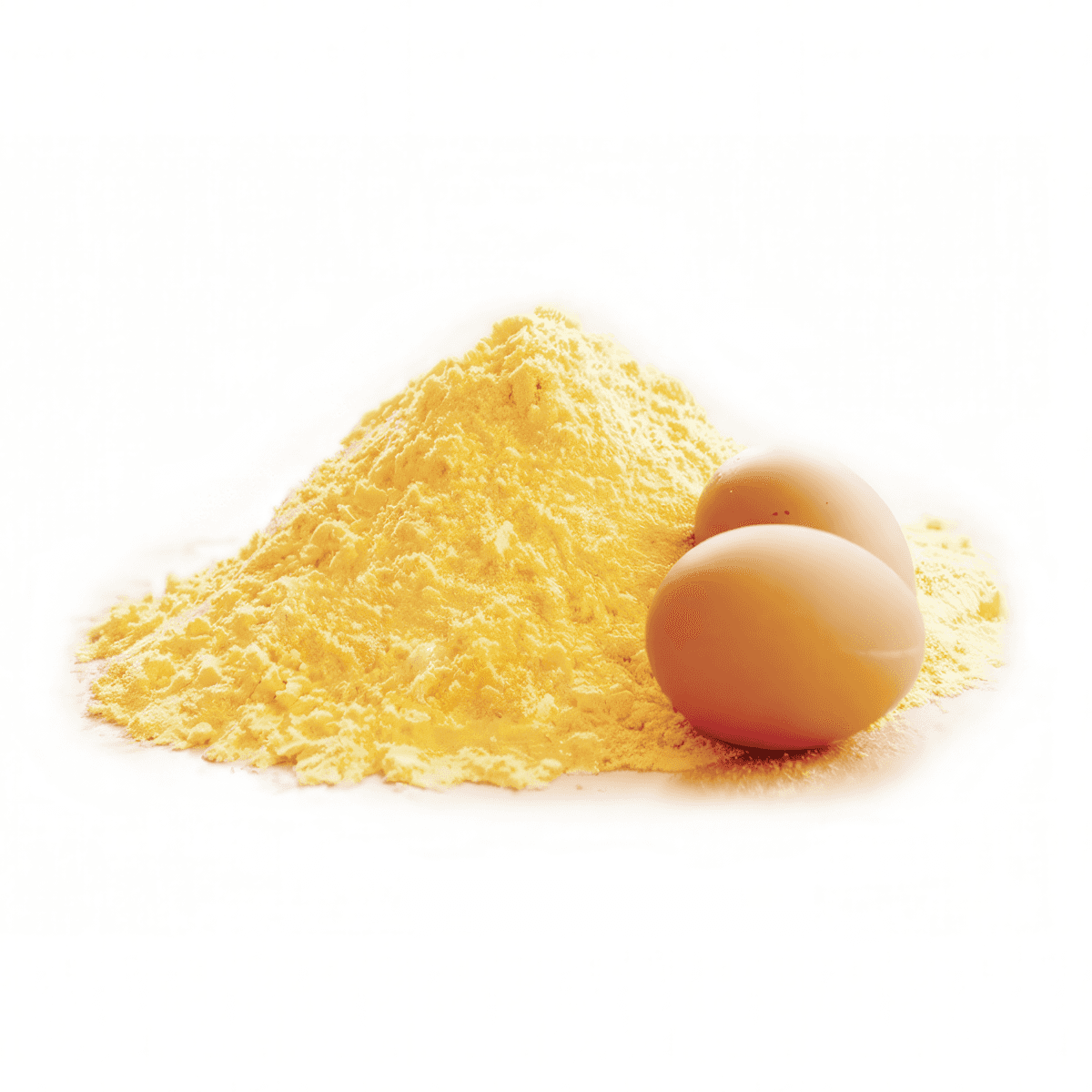

Salted Heat-Resistant Egg Yolk Powder
Storage and Shelf Life:
Packaging:
Product Description:
Applications:
Instructions for Use:
Check All Products
What Is Salted Heat-Resistant Egg Yolk Powder?
Salted heat-resistant egg yolk powder is a spray-dried egg ingredient produced by blending fresh liquid egg yolk with food-grade salt (typically 6%–8%), then dehydrating the mixture into a free-flowing pale-yellow powder. The salt addition serves two functions: it acts as a natural preservative that extends ambient shelf life to 36 months, and it modifies the yolk's lipoprotein structure to deliver enhanced emulsification stability and thermal resistance versus standard yolk powder.
Engineered for industrial emulsified systems, the powder withstands high-temperature processing (pasteurization, hot-fill, retort) and high-shear mixing without phase separation — making it a core ingredient in industrial mayonnaise, salad dressings, sauces, and ready-meal components. As an ambient-stable alternative to liquid yolks, it eliminates cold-chain logistics, simplifies dosing on automated lines, and reduces handling labor.
Choosing the Right Variant for Your Formulation
Jinyi's heat-resistant egg yolk powder is supplied in multiple industrial specifications to match different downstream applications. Variants differ along three axes: salt content (pure / 6% / 8%), carrier system (no carrier / maltodextrin / glucose syrup powder), and flow & enzyme modifications (with or without silicon dioxide anti-caking agent, with or without enzymatic treatment for enhanced emulsification).
Variant Type | Salt | Carrier System | Anti-Caking / Enzyme | Typical Application |
|---|---|---|---|---|
Pure Heat-Resistant Yolk Powder | None | None | None | Bakery, confectionery, custom in-house salt blending |
6% Salted, No Carrier | 6% | None | None | Premium mayonnaise, clean-label dressings |
8% Salted with Maltodextrin (no SiO₂) | 8% | Maltodextrin | None | Standard mayonnaise, sauces requiring clean-label carrier |
8% Salted with Maltodextrin + SiO₂ (EY) | 8% | Maltodextrin | Silicon dioxide | High-throughput industrial filling lines requiring superior flowability |
8% Salted with Glucose Syrup Powder (PT) | 8% | Glucose syrup powder | None | Sauce systems requiring enhanced solubility and mild sweetness balance |
8% Salted with Maltodextrin + SiO₂ + Enzyme | 8% | Maltodextrin | Silicon dioxide + enzymatic treatment | High-shear, high-temperature emulsification for premium industrial mayonnaise |
Custom salt levels (3%–10%), carrier ratios, and packaging available under OEM agreements.
Q1: How do I choose between maltodextrin-carried and pure egg yolk powder?
Pure yolk powder delivers the highest egg solids content and the cleanest ingredient label, but has lower flowability and higher cost-per-functional-unit. Maltodextrin-carried versions offer better spray-drying yield, easier rehydration, and lower unit cost, while remaining widely accepted on EU, US, JP, and CN ingredient labels. Most industrial mayonnaise producers choose maltodextrin-carried; bakery and confectionery often choose pure.
Q2: When is the enzyme-treated variant (CK-A0602002-00055) worth specifying?
The enzymatic treatment (typically phospholipase) modifies yolk lecithin to produce lyso-phospholipids, which deliver significantly higher emulsification stability under high-shear and high-temperature processing. This variant is recommended for industrial mayonnaise lines running pasteurization or hot-fill, retort-stable sauces, and premium dressing brands where emulsion break-down would be a quality risk.
Q3: What's the difference between maltodextrin and glucose syrup powder (PT) as carriers?
Both improve spray-drying and flowability, but maltodextrin is neutral in flavor and most widely accepted across markets. Glucose syrup powder adds slight sweetness and higher solubility, which can be preferred in specific Asian sauce profiles or where the finished product benefits from balanced sweetness — common in Korean and Japanese dressings.
Q4: Why are some variants supplied with silicon dioxide (SiO₂) and others without?
Silicon dioxide is an internationally approved anti-caking agent that ensures free-flow performance on high-speed industrial filling lines and prevents clumping during 36-month ambient storage. However, some markets (clean-label, organic, certain EU private-label specs) require SiO₂-free formulations. Jinyi supplies both options to meet differing label requirements.
Q5: Can you produce a custom specification not listed in the matrix?
Yes. Salt content (3%–10%), carrier ratio, particle size, enzymatic treatment level, and packaging (20 kg cartons, kraft bags, or custom) can all be customized under OEM agreements with minimum order quantities. Typical lead time for a new spec validation is 4–6 weeks.
CONTACT US
Contact Our Product Consultant
*Bulk Supply Only | No Retail or Small-Quantity Orders
*Fresh eggs are not our primary offering and require destination country regulatory clearance.