
Articles
Egg Product Supplier Evaluation: 5-Point Checklist
By Zhang Wei, Head of Quality Assurance, Jinyi Food | December 15, 2025
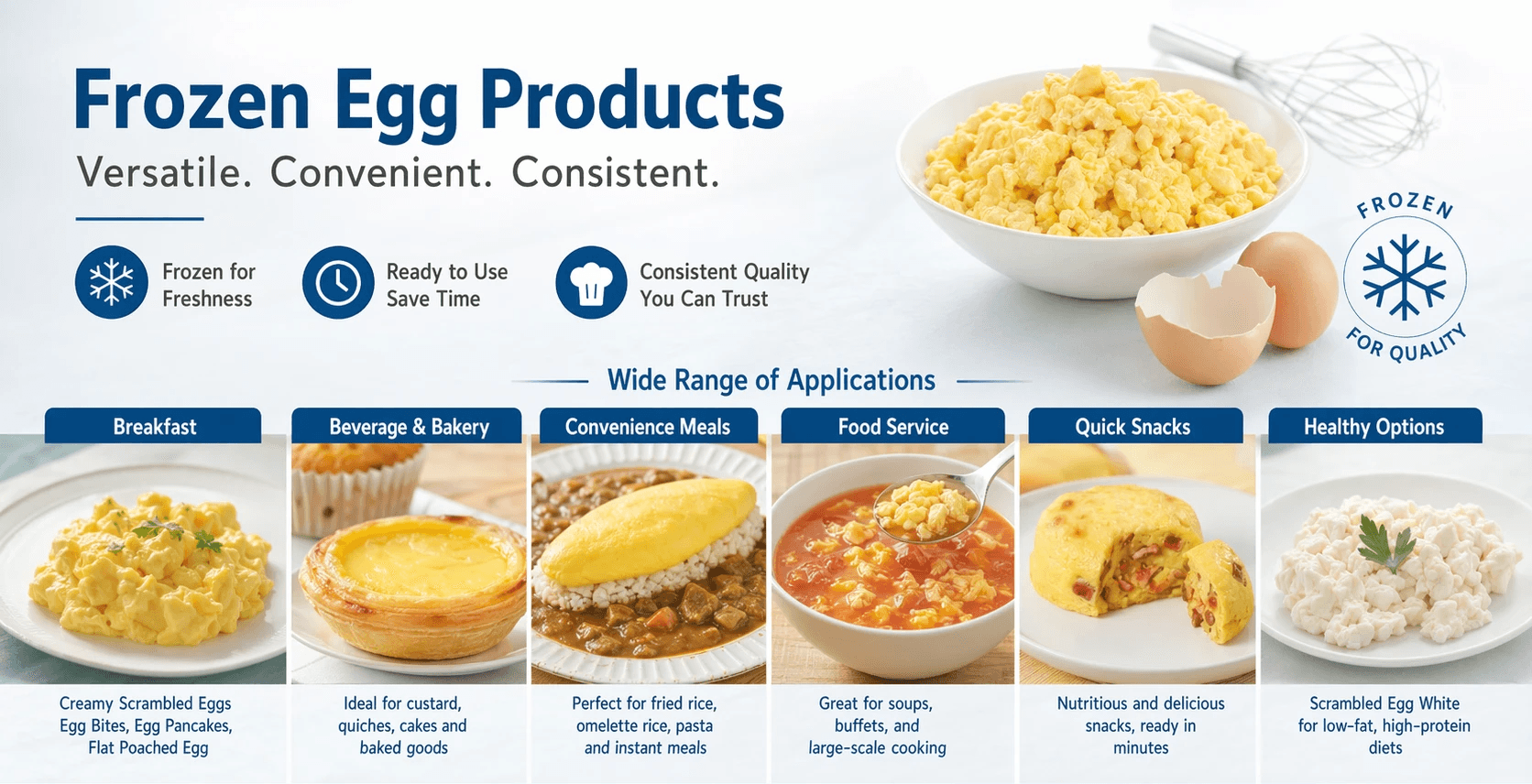
To evaluate an egg product supplier, check five things: verified certifications (FSSC 22000 v6, ISO 22000, HACCP), a traceability system that can trace any batch in under 4 hours, pasteurization and spray-drying parameters, 12 consecutive commercial COAs showing batch-to-batch consistency within 5%, and real technical support. A clean COA and a low price tell you very little — here is the checklist we use after 20 years of supplying egg products to clients in 40+ countries.
Last October, a German chain bakery contacted us in panic. Their macaron line had just scrapped a batch worth €120,000 because their egg white powder supplier's foaming volume suddenly dropped. On paper, everything looked fine: clean COA, price 8% below ours. By week 14, functional performance had collapsed.
This is the part of supplier evaluation that never appears in brochures.
1. Read Certifications Like an Auditor, Not a Buyer
Most buyers ask, "Do you have ISO 22000 or HACCP?" The better question is: "Can I see your non-conformance reports?" Those show where a supplier failed — and whether they fixed it.
What actually matters:
FSSC 22000 version — if a supplier is still on v5.1 in 2026, ask why they haven't upgraded to v6.
Certification scope — some suppliers' ISO 22000 covers only their liquid egg line, not powder.
Certification body — SGS, Bureau Veritas, DNV, and TÜV carry more weight than little-known local bodies.
Also request their three most recent SMETA audit reports (the ethical sourcing audits widely used in EU and UK supply chains). If they hesitate, that tells you something.
2. Traceability Is Only Real If It Takes Under 4 Hours
Certifications describe systems. Traceability proves the systems work.
"Farm-to-fork" has become a marketing slogan, but the test is simple: send your supplier a batch code from a shipment six months ago. Within 4 hours, they should identify the farm, henhouse, feed lot, and pasteurization batch.
At our Jilin facility, every shell egg carries a laser-coded 12-digit ID, and records are kept for 24 months. During the 2023 Salmonella scare in Eastern Europe, a Japanese customer ran this exact test at 9 PM on a Friday. We delivered a full trace back to the feed supplier in 2 hours 40 minutes.
If a supplier can't run this drill, their traceability is theoretical.
3. The Equipment Tells You What the Sales Team Won't
Twenty minutes on the production floor beats twenty hours of PowerPoint. Three things to check:
Pasteurization parameters. Ask for exact time–temperature profiles. The EU minimum for liquid whole egg is 64°C for 2.5 minutes. For egg whites, good suppliers run around 60°C for 3.5 minutes to protect foaming properties. If the plant manager can't recite this from memory, walk away.
Spray-drying tower. A well-run tower holds inlet temperature at 170–180°C and outlet at 70–80°C. Scorched particles on tower walls are a red flag for inconsistent solubility and color.
Line separation. Whole egg, yolk, and white should run on physically separate lines. Time-based separation with cleaning in between is not enough — cross-contamination is the most common reason private-label customers reject batches.
4. Batch Consistency Is Where Most Suppliers Fail
"The sample was perfect, but production is all over the place." Every procurement director has said this at least once. Many suppliers hand-pick their sample batches — the R&D sample you tested is not what arrives on pallet 47 of container 3.
Ask for:
12 consecutive COAs from actual commercial shipments, not cherry-picked results.
Functional performance data over time — foam volume, emulsification capacity, and solubility should vary less than 5% batch to batch.
Customer references with 3+ years of purchase history — not the logos on the homepage.
Our internal spec for egg white powder foaming volume is 520 ± 15 ml, and we quarantine any batch beyond ± 10 ml. Ask your supplier what their tolerance is — and whether they actually enforce it.
5. Technical Support Is the Hidden Cost
A supplier who saves you 5 cents per kilo but can't solve a stability problem at 3 AM before a production run isn't cheaper. They're more expensive.
A partner worth keeping offers:
Application-specific R&D — someone who actually understands macaron structure or mayonnaise emulsion.
On-site troubleshooting — a real person at your plant within 72 hours when something goes wrong.
Formulation co-development — one of our US clients cut egg yolk usage by 14% after our team reformulated their sauce base.
Over a three-year horizon, the cheapest supplier almost never wins.
FAQ
What is the minimum certification a food-grade egg supplier should have?
At minimum, ISO 22000 and HACCP. FSSC 22000 is effectively mandatory for exports to the EU and North America. Depending on your end markets, you may also need Halal (JAKIM) or Kosher (OU) certification.
How can I verify a supplier without visiting the factory?
Three steps: request a live video audit of the production line (we have run 200+ since 2020), ask for third-party audit reports from bodies like SGS or Bureau Veritas, and call three customer references with real purchase history — not names from a brochure.
How do I test a supplier's traceability system?
Send them a batch code from a shipment made six months ago. A supplier with working traceability should identify the farm, feed lot, and pasteurization batch within 4 hours. If they can't, the system only exists on paper.
Why does egg white powder foaming performance vary between batches?
The usual causes are inconsistent pasteurization temperatures, scorched particles from poorly maintained spray-drying towers, and hand-picked sample batches that don't represent commercial production. Ask for 12 consecutive commercial COAs to see the real variation.